Understanding Time Signatures
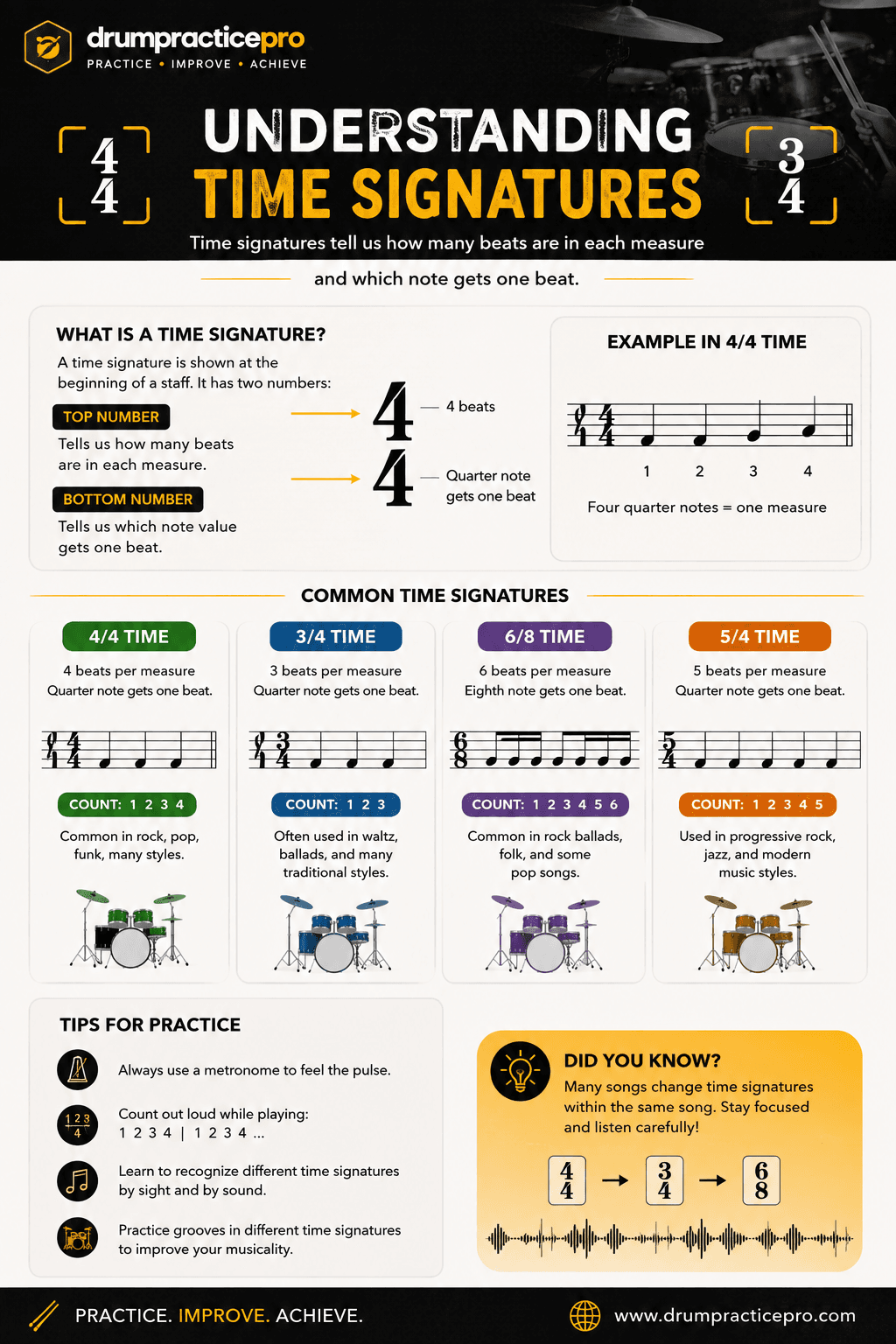
A time signature tells every player in the band how many beats land in each bar and which note gets counted as one beat. Learn to read one at a glance and you can sit in on almost any song — rock, jazz, waltz, or shuffle — and know exactly where the pulse lives.
How to Read a Time Signature
4/4 — Common Time
4/4 is the time signature you'll play more than any other. Count four beats to a bar with the quarter note as your beat, and that's the whole rule. Rock, pop, blues, funk, and country all default to it, which is why every drummer learns to lock into 4/4 before anything else.
3/4 — Waltz Time
3/4 time drops one beat from the bar, and that missing beat is what gives waltz time its lean. Count '1 2 3, 1 2 3' and you'll feel the music circle rather than march — it never quite lands flat the way 4/4 does.
6/8 — Compound Duple Time
6/8 packs six eighth notes into the bar, split into two groups of three. Count all six while you're learning it, but once it settles into your hands you'll feel only two big pulses, each rolling through three subdivisions — a compound meter that grooves very differently from straight 4/4.
Simple vs. Compound Time
Frequently asked questions
What does 4/4 time mean in music?
4/4 time means there are 4 beats per measure and a quarter note gets one beat. It is the most common time signature in rock, pop, and jazz. A standard rock drum beat with the snare on beats 2 and 4 is in 4/4 time.
What does 3/4 time sound like on drums?
3/4 time has three beats per bar instead of four, giving music a waltz-like feel. On drums the snare typically falls on beat 2 or beats 2 and 3. It is heard in songs like 'Manic Depression' by Jimi Hendrix.
What is 6/8 time in drumming?
6/8 time has six eighth-note beats per bar, grouped into two sets of three. It creates a flowing, compound feel common in blues shuffles and ballads. At faster tempos it often sounds like a two-beat feel.
What is the difference between 3/4 and 6/8 time?
Both can feel like 'three', but 3/4 is a simple meter (three quarter-note beats per bar) while 6/8 is a compound meter (six eighth-note beats grouped as two sets of three). At slow tempos they sound similar; at faster tempos, 6/8 feels like a driving two-beat pulse.
What is the top number in a time signature?
The top number (numerator) in a time signature tells you how many beats are in each measure. For example, 4/4 has 4 beats per measure and 3/4 has 3 beats per measure.
What is the bottom number in a time signature?
The bottom number (denominator) in a time signature tells you which note value equals one beat. A 4 means a quarter note gets one beat; an 8 means an eighth note gets one beat.