How to Read Drum Sheet Music
Drum music uses a 5-line staff where each position represents a different drum or cymbal. Hover or tap any note below — then click to hear it.
Anatomy of the Drum Staff
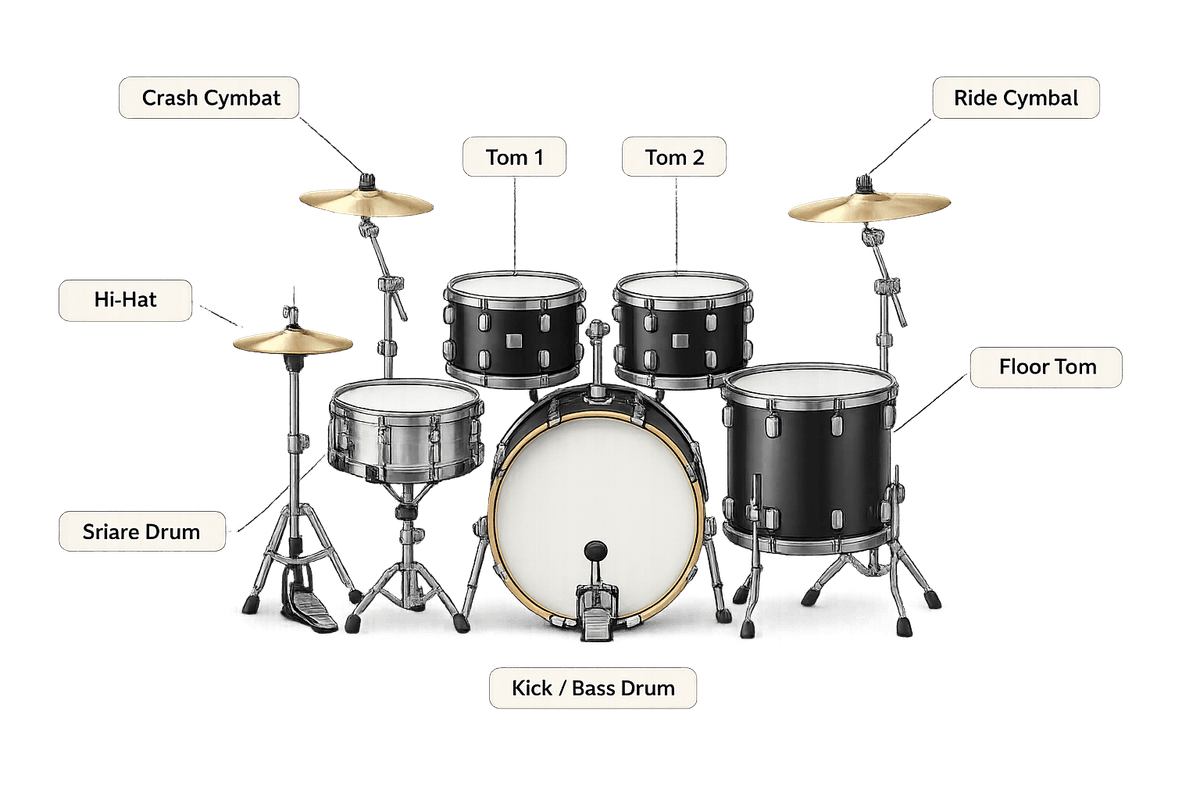
All Drum Positions — Click to Hear
Tips for Reading Drum Notation
- Look at the time signature first — it tells you how many beats are in each bar and which note value counts as one beat.
- Read both voices at once: the top voice (stems up) covers cymbals and hi-hats, the bottom voice (stems down) covers kick and snare.
- Count out loud while reading: '1 e & a 2 e & a' for sixteenth-note grooves, or '1 & 2 & 3 & 4 &' for eighth-note patterns.
- Bar lines divide the staff into equal measures. Each measure contains exactly the number of beats shown in the time signature.
- Notes at the same horizontal position are played at the same time — for example, a hi-hat and kick on beat 1.
Frequently asked questions
What does drum notation look like?
Drum notation is written on a five-line staff using a neutral clef. Each drum or cymbal occupies a specific line or space. Regular noteheads are used for drums and X-shaped noteheads for cymbals like hi-hat, ride, and crash.
Where is the kick drum on a drum staff?
The kick drum (bass drum) is written in the bottom space of the five-line staff, just above the bottom line, typically with a downward stem.
Where is the snare drum on drum sheet music?
The snare drum is written on the third space from the bottom of the five-line staff.
What does an X notehead mean in drum music?
An X notehead in drum notation represents cymbal strikes, including hi-hat, ride cymbal, and crash cymbal. The exact cymbal depends on its position on the staff.
What clef is used for drum notation?
Drum music uses a neutral clef, shown as two vertical lines at the start of the staff. Because drums are unpitched instruments, they do not use treble or bass clef.